REPIC : A PROGRAM TO RESTORE POSIDONIA SEAGRASS BEDS !
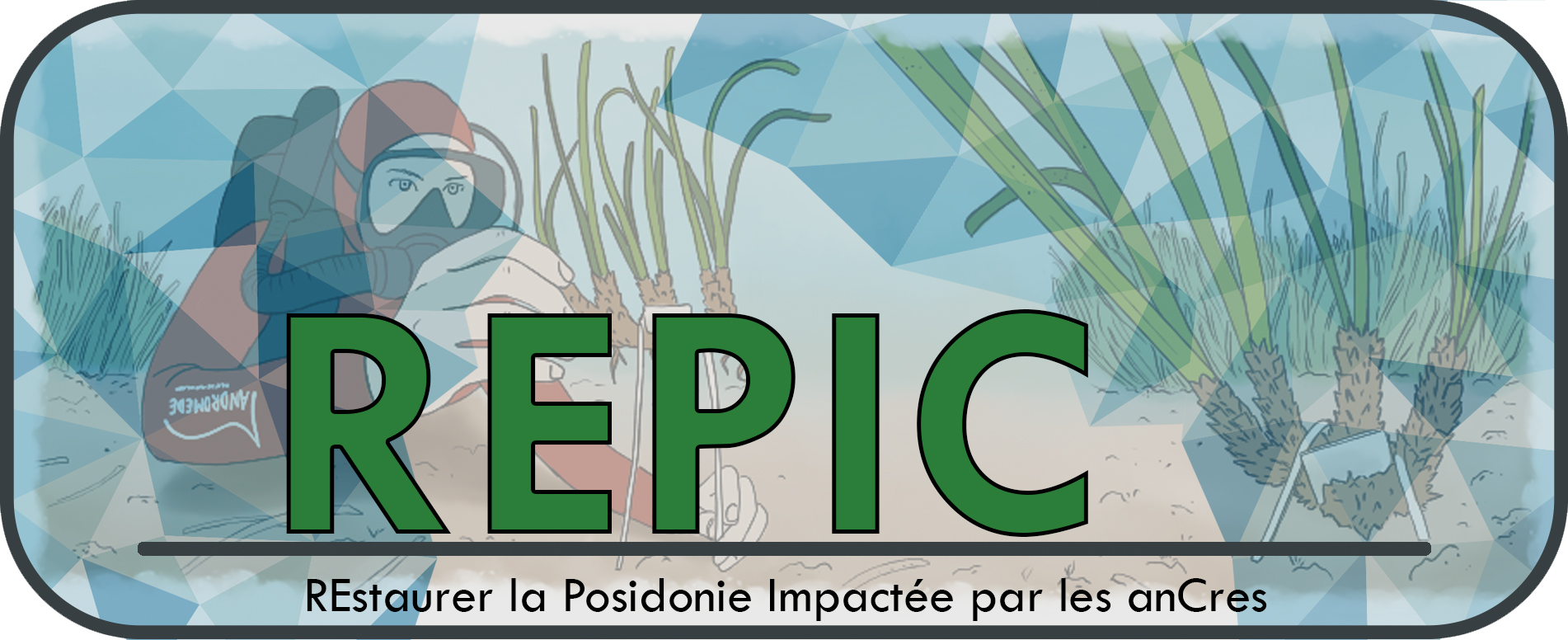
The REPIC program (Restoring Posidonia Affected by Anchors) was launched in 2019 by Andromède Océanologie and L’Oeil d’Andromède in partnership with the Rhône-Méditerranée-Corse Water Agency and NAOS. From 2022 to 2024, the program received support from new partners: the Fondation de la Mer and the Fondation Artelia. Starting in 2024, the project is supported by the Fonds Nature 2050 and the Fonds MAIF pour le vivant. REPIC enables the replanting of fragments of Posidonia seagrass meadows at restoration sites particularly impacted by anchoring, thereby initiating a restoration process (population reinforcement) for these meadows. The program uses a collection technique that has no impact on the seagrass meadows: the planting of floating bundles torn up by anchors during the summer season (or broken off naturally). These fragments offer the following advantages: high availability, moderate collection effort, and zero impact on existing populations. These fragments are transplanted into areas of dead mat using biodegradable metal staples specially designed for the project.
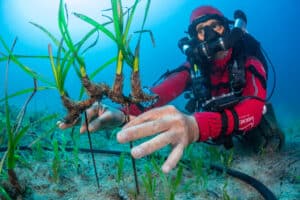
Transplanting is done by hand in predefined areas after the fragments have been secured with a biodegradable staple. @Andromède Océanologie.
Since the program was launched seven years ago, three restoration sites (Golfe Juan, the harbor of Beaulieu-sur-Mer, and the harbor of Villefranche-sur-Mer, at depths ranging from 1.5 to 30 meters) have been identified. Due to past damage to the Posidonia seagrass beds and new protective measures put in place (notably regulations on anchoring), these geographical sites within the REPIC program now constitute restoration areas well-suited for testing new methods of restoring these seagrass beds.
Between 2019 and 2024, the program has been refined and improved. The actions undertaken since the start of REPIC have made it possible to select the transplanting method and the chosen areas, to test the effect of depth on the survival of transplants, to analyze energy recovery over the years, and to track trends in the progression, regression, or stabilization of the seagrass meadow undergoing restoration, etc. Robust monitoring indicators therefore make it possible to evaluate the effectiveness of restoration measures over time using various methods (photogrammetry, tuft counting, laboratory analyses), and constitute a solid database conducive to the analysis and understanding of the results. The year 2025 marks the end of the experimental phase and the beginning of the expansion of restoration areas using an adapted and optimized method.
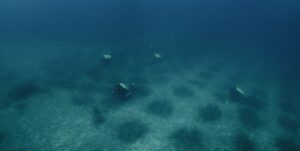
Divers replanting fragments of Posidonia at the restoration site of Beaulieu-sur-Mer, REPIC 2024 (©Andromède Océanologie)
Thanks to the various campaigns conducted between 2019 and 2025 (224 days in the field, 1,352 hours of diving), the total restoration area reached 5,700 m² with more than 396 000 transplanted shoots. The scientific monitoring data is processed and made available on the online mapping platform for monitoring Mediterranean coastal waters and ecosystems, MEDTRIX (http://plateforme.medtrix), as part of the RESTAU-MED project, which showcases ecological restoration projects. For more information on this network, please visit the RESTAU-MED project page.
The next REPIC project missions, scheduled for summer 2026, will allow us to continue our work at the restoration sites in Beaulieu-sur-Mer, Golfe-Juan, and Villefranche-sur-Mer in an efficient manner.
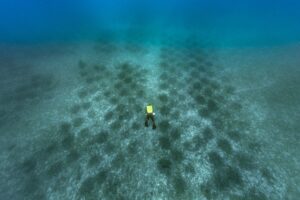
Diver above the restoration site at Beaulieu-sur-Mer, REPIC 2023 (©Laurent Ballesta)
Contact : Gwenaëlle Delaruelle, gwenaelle.delaruelle@andromede-ocean.com; Jo-Ann Schies, joann.schies@andromede-ocean.com
Project leaders : Andromède Océanologie and l’Œil Andromède
Update frequency : Annual
Partners : A project supported by NAOS, l’Agence de l’eau Rhône Méditerranée et Corse, la Fondation de la Mer, la Fondation Artelia, le Fonds MAIF pour le vivant et le Fonds Nature 2050.

Un projet soutenu par